What Is Slow Fashion Jewelry? A Plain-English Guide
Last Updated: November 22, 2026
Quick Summary
Slow fashion jewelry is jewelry made to be kept, worn and repaired rather than replaced every season. It uses well-made, durable materials and timeless designs, so a piece stays relevant for years. Its value is measured in cost per wear, not just the starting price.
- Judge slow jewelry by four questions: durability, who made it, materials, and whether it can be repaired.
- A $20 fashion ring worn for two months costs more per wear than an $82 sterling ring worn daily for years.
- Recycled metal labels show where the metal came from, not that the piece is low-impact overall.
- Plated base-metal pieces can lose their finish within weeks, while solid metal can be refinished and resized.
- Ask any maker whether a piece can be resized, have a stone reset, or be refinished.
Slow Fashion Jewelry Explained
Slow fashion jewelry is jewelry made to be kept, worn and repaired rather than replaced every season. I write about it because it is the clearest alternative I know to the disposable accessories sold alongside every new trend. Slow jewelry is the idea that a piece should be well made, built from materials that hold up, and designed to stay relevant for years. Slow fashion jewelry is a slow jewelry approach applied to the everyday pieces most people buy, like rings, earrings and bracelets.
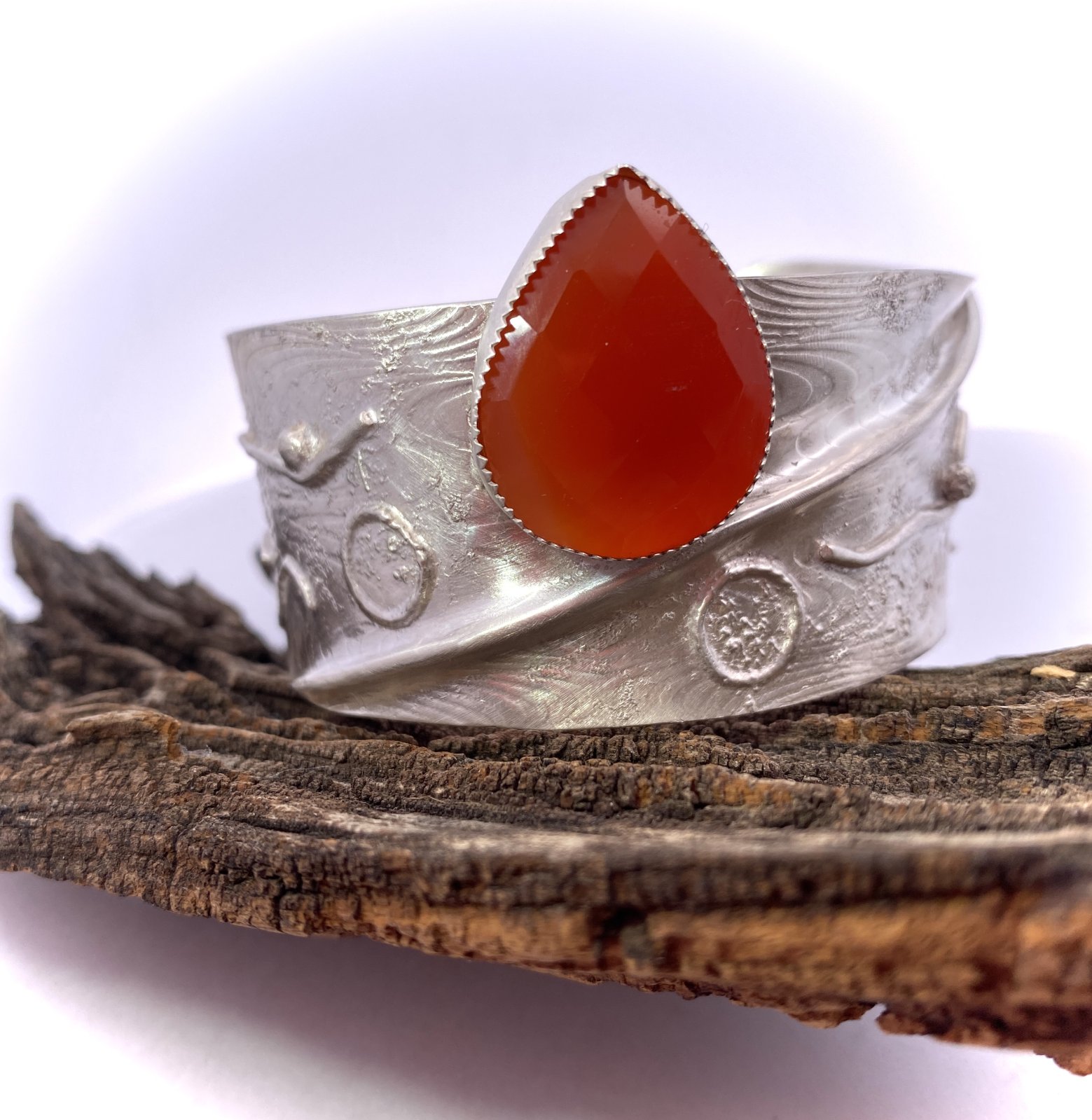
Carnelian Gemstone cuff bracelet
The term gets used loosely, so it helps to be precise. Fast fashion jewelry is designed quickly, produced in large volumes and priced to be replaced. Slow jewelry flips that logic. That shift changes what you buy and how often you buy it.
Here is what I think most shoppers get wrong. They assume slow jewelry is simply more expensive. Sometimes it costs more upfront, but a well-made sterling ring worn daily for years often works out cheaper per wear than a trend piece that tarnishes in months.
What Slow Jewelry Meaning Covers in Practice
The slow jewelry meaning goes beyond price. In practice, it covers four things: how long a piece is meant to last, who makes it and under what conditions, what materials it contains, and what happens when it wears out.
Durability comes first. A piece built with solid construction and sound finishing can be worn for years. Craftsmanship matters because handmade work, done by a person who controls each step, tends to show fewer weak points than mass production. Materials matter because metals and gemstones carry their own sourcing questions. Finally, end-of-life matters: can the piece be repaired, resized, reset or resold?
I use these four questions as a quick filter. A piece that fails most of them is probably fast jewelry, whatever it is called.
Slow Jewelry vs Fast Fashion Jewelry
The main difference between slow jewelry and fast fashion jewelry is intent. Fast jewelry is built to sell now and be replaced soon. Slow jewelry is built to be worn for a long time.
Fast fashion jewelry usually relies on base metals with a thin plating that wears through, low-cost stones or glass, and designs that follow short-lived trends. Slow jewelry tends to use precious metals such as sterling silver or gold, gemstones with a known origin, and timeless shapes that do not date quickly.
Price per wear is where the comparison becomes concrete. A $20 fashion ring worn for two months and thrown away costs far more per wear than an $82 sterling ring worn daily for years. For example, the Sterling Silver Ring from the Sacred Spiral Collection at Alene's Adornments is the kind of everyday piece I mean: smooth, classy and meant to be worn constantly.

Sustainable Jewelry Materials and Their Trade-Offs
Materials are where sustainability claims get complicated, so I want to be direct about the trade-offs. No metal or stone is automatically the "green" choice, and treating all "sustainable" materials as equivalent is the most common mistake I see. Here is how the main options actually compare.
Recycled versus newly mined metals. Recycled sterling silver and recycled gold reduce demand for newly mined metal, which avoids the land disturbance, water use, and energy of extraction. That is a real benefit.
Solid metal versus plated base metal. This is the trade-off most shoppers overlook. A cheap plated piece can look convincing for weeks, then shed its finish. Solid metal holds up better than thin plating, and it can be refinished, resized, and repaired.
Gemstones. Gemstones such as turquoise, garnet, and amethyst vary widely in how they are sourced, and the variation matters more than the stone type. Ask where a stone came from and whether it is natural, lab-grown, or treated.
Alternative and lower-impact materials. Wood, resin, glass, and recycled-content composites can lower the mining footprint, but they often trade durability for that benefit. A resin piece that cracks in a year is not slow, whatever its material story.
!Craftsperson's hands shaping a silver band at a workbench in a small Arizona studio, with turquoise and garnet stones laid out nearby
Watch out: a "recycled" or "eco" label on a plated base-metal piece can disguise the same short lifecycle as any fast-fashion item, so check the core metal and the construction before the marketing words.
Materials are where sustainability claims get complicated, so here is how the main options compare, using the trade-offs covered in this section.
Material |
Main benefit |
Main trade-off |
|---|---|---|
Recycled metal |
Avoids newly mined metal |
Recycled label does not mean low-impact overall |
Solid metal |
Holds up and can be refinished |
Costs more upfront |
Plated base metal |
Looks convincing at first |
Finish wears off within weeks |
Natural gemstones |
Can come from responsible small-scale mining |
Opaque supply chains are common |
Lab-grown gemstones |
Avoids mining entirely |
Carries its own energy footprint |
Resin or wood |
Can lower mining footprint |
Often less durable |
How to Choose Sustainable Jewelry
Choosing sustainable jewelry comes down to three decisions: what the piece is made of, who made it, and whether it will last. If you want a quick way to judge artisan quality beyond these questions, see how to tell if artisan jewelry is high quality. I start with the material and work outward from there, because the material shapes everything else about the piece's life. But the real skill is telling evidence from a slogan, so I treat every claim as a question until the seller answers it.
Pick solid sterling or gold over plated base metals whenever you can. Favor designs that suit your everyday wardrobe, since a piece you reach for daily earns back its cost faster. And look for makers who explain their process in plain language, because vague claims usually mean there is little to explain.
For a handmade option, the Faceted Garnet & Textured Sterling Silver Ring in size 8 is a good example of a one-of-a-kind piece built around solid silver and a gemstone with a clear birthstone story. Pieces like this are made to be worn, not replaced.
A Buyer's Checklist for Verifying Claims
Brands use words like "sustainable," "ethical," and "handmade" freely, so I check claims before I trust them. The goal is to separate evidence from adjectives. Here is what I look for, grouped by the kind of proof each claim requires:
Material disclosures. Does the seller name the metal exactly, such as sterling silver (92.5% silver) or 14k gold, rather than just "silver" or "gold tone"? Does the listing say whether stones are natural, lab-grown, or treated, and where they are from? A specific material disclosure is the baseline; without it, nothing else can be verified.
Sourcing documentation. Can the maker say where the metal and stones came from, and whether recycled content is certified? For gemstones, is there any origin information at all? A seller who can describe the supply chain in plain language is more credible than one who repeats a certification logo without explanation.
Production details. Can the maker describe how the piece is made and by whom? Is it made in a small studio, in batches, or mass-produced? Handmade is a production method, not automatically an ethical or low-impact one, a handmade piece can still use poorly sourced stones or unsafe finishing.
Certifications and standards. Look for recognized third-party marks where they apply, such as Fairmined or Fairtrade for gold, or Responsible Jewellery Council membership for larger operations. A certification is useful evidence, but it covers specific claims, not the whole piece. Do not let one logo stand in for every question.
After-purchase support. Is there a repair, resize, or refinish option? A seller who stands behind a piece after the sale is signaling that it was built to last.
If a seller cannot answer most of these, treat the sustainability claim as unproven. That is not an accusation; it just means you have no evidence yet.
Care, Repair, and Cost per Wear
Care is what turns a good piece into a long-lasting one. Store sterling away from humidity, wipe it after wearing, and avoid harsh chemicals and swimming.
Repair is the other half of the equation. Ask any maker whether a piece can be resized, have a stone reset or be refinished.
Cost per wear puts it together. Divide the price by the number of times you expect to wear the piece. A durable ring you wear every day for five years has a very low cost per wear, even at a higher starting price.
Booking a Consultation for a Piece Built to Last
If you are considering a custom piece, a consultation is the best way to make sure it will suit you. Alene's Adornments offers both in-person consultations and Zoom meetings, so you can talk through materials, stones and sizing before anything is made. Start with the Alene's Adornments guide to custom timing, which covers what to expect before you book.
I would rather you ask questions up front than end up with a piece that does not fit your life. Join my Collector's List today.
Frequently Asked Questions
What is slow fashion jewelry?
Slow fashion jewelry is accessories made to be kept and worn for years rather than replaced each season. It usually means small-batch or handmade production, durable metals such as sterling silver and gold, and designs that are not tied to a short-lived trend. The idea borrows from slow fashion in clothing, where buyers choose fewer, better-made pieces. Slow jewelry does not have one legal definition, so the practical test is whether a piece is built to last, made with care, and bought with intent.
How is slow fashion jewelry different from fast fashion jewelry?
Fast fashion jewelry is produced in large volumes, often with base metals and chemical plating, and designed to follow the newest trend. It tends to tarnish or break within months. Slow fashion jewelry is made in smaller runs, usually with more durable materials, and is designed to stay wearable for years. The price per piece is often higher, but the cost per wear can be lower because the piece lasts longer.
What materials are commonly used in slow fashion jewelry?
Common choices include sterling silver, gold, copper, steel, and natural gemstones such as turquoise, garnet, malachite, and amethyst. Sterling silver and gold resist wear better than many plated base metals. Gemstones vary in hardness and care needs, so check each stone's durability before choosing a piece for daily wear. Each material has trade-offs in cost, maintenance, and environmental impact.
How can you tell whether jewelry is sustainably made?
Start by asking the maker where the metal and stones come from, how the piece is made, and whether it can be repaired. Look for specific details rather than broad claims such as 'eco-friendly.' A maker who can name their materials, describe their production, and explain their care options is usually more transparent. Use the checklist in this guide to compare claims before you buy.
How do you care for jewelry so it lasts longer?
Store pieces separately to prevent scratching, remove jewelry before swimming or showering, and avoid harsh chemicals. Silver should be cleaned gently and stored in an airtight bag to slow tarnish. Porous gemstones such as turquoise need extra protection from water, lotions, and heat. Regular checks for loose settings or worn clasps catch small problems before they become repairs.
Is handmade jewelry always sustainable?
No. Handmade means the piece was made by hand, but it does not guarantee responsible sourcing, durable materials, or fair labor practices. A handmade piece in a cheap plated metal can still wear out quickly. Ask about materials and sourcing as well as how the piece was made.
What is the difference between slow, sustainable, and ethical jewelry?
Slow jewelry focuses on longevity and intentional buying. Sustainable jewelry focuses on reducing environmental impact through materials and production choices. Ethical jewelry focuses on fair labor and responsible sourcing. A piece can meet one of these standards without meeting the others, so ask which one matters most to you.