
How to Identify Real Moonstone: A Visual Guide
Last Updated: October 17, 2026
What Real Moonstone Looks Like: Adularescence and Body Color
Real moonstone is a feldspar gemstone defined by one signature feature: a floating, billowy sheen of light that moves as you tilt the stone. That glow is called adularescence, and it is the single most important thing to check when learning how to identify real moonstone.
Adularescence is the optical effect of light scattering between microscopic layers inside the stone. Those layers formed as the gem cooled over millions of years. No factory can copy that structure perfectly, though many have tried.
The Billowy Sheen Explained
The sheen should look soft and cloud-like, like moonlight drifting across water. It shifts position as the stone moves. It never sits flat or looks printed on.
A real stone shows this effect from inside. Fakes often show a flat, painted-on shimmer instead. This is what I love about this gem. You can view it from all angles and see the shimmer.
Common Body Colors and Transparency Levels
Moonstone comes in several body colors, and most stones fall somewhere on a scale from translucent to nearly opaque:
- Colorless to milky white with a blue sheen, the classic look
- Gray, brown, or pale yellow with a silver or white glow
- Pale peach with a warm, sunset-like flash
- Translucent to semi-transparent in finer stones
- Opaque in lower-grade material, where the sheen is weak or absent
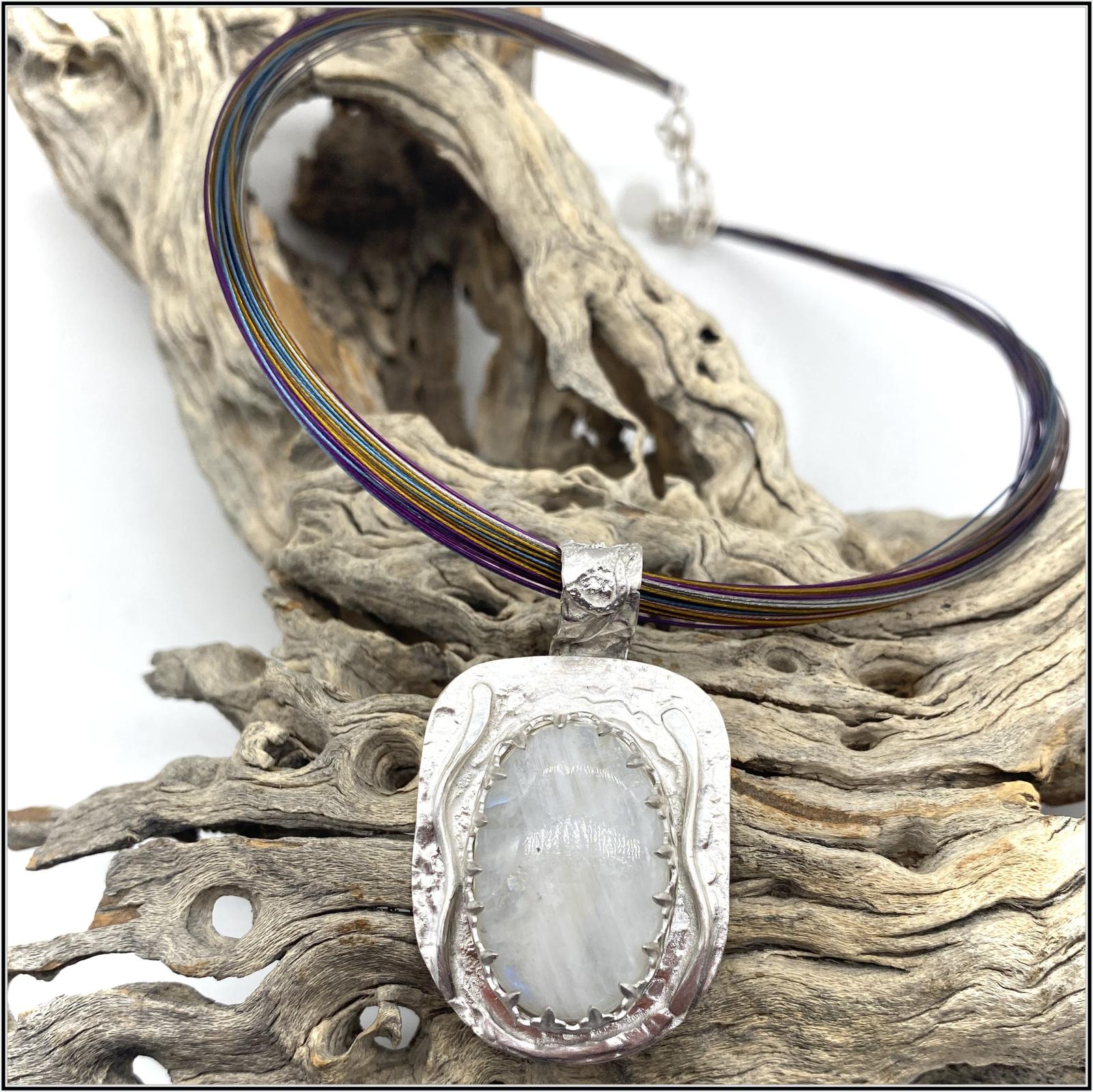
An Oversized moonstone gem encased in sterling silver.
Real vs Fake Moonstone: A Step-by-Step Checklist
The fastest way to separate real vs fake moonstone is a repeatable visual routine done in controlled light. Work through the steps in order, score each one, and treat any stone that fails two or more as suspect.
Before you start: clean the stone with a soft cloth, remove it from any closed-back setting if you can, and work at a window with indirect daylight plus one warm lamp. A loupe at 10x magnification is the only tool you need.
- Tilt the stone slowly under the lamp, then under daylight. Watch the sheen move. Real adularescence rolls and shifts position as the angle changes; it does not sit in one spot.
- Check the sheen's depth. It should appear to float inside the stone, below the surface. A surface-only shimmer points to a coating or a foil-backed imitation.
- Look for natural inclusions. Under 10x, expect thin fissures, faint growth lines, and tiny mineral traces. Perfectly clean interiors are more common in glass than in natural feldspar.
- Compare the flash against the body color. Real adularescence blends into the stone's base color at the edges. A flash that stops abruptly or looks painted on is a warning sign.
- Weigh the stone in your hand. Feldspar feels denser than plastic of the same size; plastic also warms quickly against your skin.
- Inspect the edges and the side profile with a loupe. Round air bubbles suggest glass. A visible seam or glue line suggests an assembled stone.
Step 1: Inspect the Stone Under Different Lighting
Lighting changes everything. A stone that looks stunning in a jewelry store spotlight can look dull in daylight, and the reverse is also true.
Take the stone to a window. Then step into a dim room. A genuine gem keeps some sheen in both settings. A fake often only sparkles under one type of light. The reason is that adularescence comes from light scattering between microscopic layers inside the stone, so it responds to the direction and quality of the light source rather than to a single bright beam.
Step 2: Look for Natural Inclusions and Fissures
Natural moonstone almost always carries small internal features. These include thin fissures, tiny mineral traces, and faint growth lines. They are not flaws. They are fingerprints of nature. Tiny microscopic line are normal. Many also have pockets of black, which is natural tourmaline.
Glass and plastic imitations are usually too clean. They look perfect inside, and that perfection is the giveaway. Under 10x magnification, glass often shows round bubbles, while natural feldspar shows irregular, angular features.
Step 3: Confirm the Stone's Identity Before You Buy
If the checklist leaves you uncertain, ask the seller three direct questions: What is the stone's variety? Is it natural, treated, or assembled? Can you provide a written disclosure? A reputable seller names the stone and its variety and states any treatments in writing. If the listing stays vague, treat that as a fail and move on.
How to Tell If Rainbow Moonstone Is Real
Rainbow moonstone is actually a variety of labradorite, not true moonstone, and it shows a full spectrum of flash colors instead of a single blue or white sheen (Moonstone Description). Knowing this one fact helps you avoid a common trap: sellers sometimes label any flashy feldspar as "rainbow moonstone" to charge more.
Here is how to tell if rainbow moonstone is real:
- The flash should show distinct blues, greens, and golds as you tilt it
- The base is usually colorless to white, not milky
- The effect is sharper and more metallic than classic moonstone's soft glow
- Internal fissures should still be visible under magnification
If the colors look sprayed on or fade at the edges, walk away.
Simulated Moonstone: Glass, Plastic, and Assembled Imitations
Simulated moonstone covers more than glass and plastic. It also includes assembled stones, treated stones, and lab-grown material sold without disclosure. Each category fails a different part of the checklist, and each one calls for a different question at the counter.
'Slice of Moonlight' Moonstone Sterling Teardrop pendant 1 1/2" tall →
Fake Type |
What Gives It Away |
At-Home Check |
|---|---|---|
Glass |
Round air bubbles, sharp "ping" sound, too-clean interior |
Tap gently, inspect with a 10x loupe |
Plastic |
Warm to the touch, very light, soft surface |
Weigh it against a real stone, check for warmth |
Assembled doublet |
Glue line under the crown, sheen only on top |
Look at the stone's side profile with a loupe |
Coated stone |
Sheen sits on the surface, wears off at edges |
Compare the flash at the center and the edge |
Lab-grown or treated feldspar |
Looks natural, no visible flaw |
Ask for written disclosure; visual checks cannot confirm |
Assembled Stones: The Hardest Case
Assembled stones are the trickiest. A thin slice of real moonstone is glued onto a cheaper base, or a clear top is cemented over a foil or colored layer. The sheen is real, but only in one thin layer. Check the side of the stone with a loupe. A visible seam, a color change at the girdle, or a sheen that appears only on the crown and disappears on the pavilion means it is assembled.
Treatments and Disclosure
Treatments are less common in moonstone than in many colored gems, but they exist. Surface coatings can boost a weak sheen, and dye or filler can mask fractures. Because these treatments sit on or just under the surface, they can wear away with cleaning and daily wear. The practical rule is simple: any treatment should be disclosed in writing. Ask whether the stone is natural, treated, or assembled, and ask for the answer in writing.
How Setting, Lighting, and Cut Affect the Visible Sheen
A beautiful stone can look dull in the wrong setting. A closed-back setting blocks light from behind, which kills the sheen on a translucent stone. Open-back settings let light pass through and bring the glow to life.
Cut matters just as much. A well-cut cabochon, meaning a smooth dome with no facets, shows adularescence best.
Lighting is the third factor. Incandescent and warm LED bulbs flatter blue and peach sheens. Cool white office lighting washes them out.
Setting, cut, and lighting can make a genuine stone look fake and a fake look genuine. Always judge the stone itself first, then judge how the setting displays it.
Moonstone Value and Price: What Affects the Cost
Moonstone value and price come down to four factors: color, clarity, cut, and carat weight. These are the same four Cs used across the gem trade.
A stone with a strong, centered blue sheen on a clean, translucent body commands the highest prices. Weak or patchy sheen drops the value fast.
At Alene's Adornments, our moonstone pieces are one of a kind, so the stone's character drives the design. You can see the range in our Slice of Moonlight Moonstone Sterling Teardrop pendant, where the gem's opalescent quality is set against textured fine silver.


When to Get Professional Verification for Real Moonstone
Home checks catch most fakes, but some stones need a trained eye. Send a piece for professional verification if:
- You are spending a significant amount on a single stone
- The seller cannot confirm the stone's origin
- The sheen looks real, but something about the stone feels off
- You are buying for resale or insurance purposes
A gemologist can use a refractometer and specific gravity test to confirm feldspar in minutes. These tools measure how light bends through the stone and how dense it is. No imitation passes both tests.
For everyday buyers, a written disclosure from the seller matters more than a lab report on a modest piece. Reputable sellers name the stone, its variety, and any treatments. If a listing stays vague, ask direct questions before you buy.
Frequently Asked Questions
Is real moonstone expensive?
Real moonstone prices vary widely based on size, clarity, and the strength of the adularescence. A high-quality blue sheen moonstone can cost $50 to $300 per carat, while lower-grade stones with weak or no visible flash may sell for under $10 per carat. Rainbow moonstone and stones with strong blue sheen command higher prices. At Alene's Adornments, moonstone pendants range from $195 to $210, and rings from $95 to $115, reflecting the one-of-a-kind craftsmanship and sterling silver settings.
Can you identify moonstone at home without damaging it?
Yes, you can perform several safe at-home checks. Examine the stone under different lighting angles to see if the adularescence shifts and moves. Look for natural inclusions and fissures with a magnifying glass. Check the stone's weight and temperature against known materials. However, at-home tests cannot definitively distinguish natural moonstone from high-quality synthetic or assembled stones. For certainty, especially on valuable pieces, professional gemological testing is recommended.
What is simulated moonstone?
Simulated moonstone is any material made to imitate natural moonstone but not mined from the earth. This includes glass with a milky finish, plastic with a painted sheen, or assembled stones where a thin layer of real moonstone is glued onto a cheaper base. Simulated stones often have a uniform, flat flash that looks the same from every angle, while real moonstone's adularescence shifts and moves as you rotate the stone.
How can you tell real rainbow moonstone from a fake?
Real rainbow moonstone is actually a variety of labradorite, not true moonstone, and it shows a multicolor flash of blue, green, yellow, and orange. To spot a fake, check if the flash looks painted on or sits only on the surface. Real rainbow moonstone has internal fissures and a translucent to opaque body. If the stone is perfectly clear with no internal features and the flash looks like a sticker, it is likely glass or plastic.
Spotting a fake takes practice, but the payoff is a piece you can trust for decades. At Alene's Adornments, every moonstone is hand-selected and set in our Arizona studio, so the sheen you fall in love with online is the sheen you see in person. Each piece ships free, arrives gift wrapped, and comes from 16 years of design experience in fine and sterling silver. Join my Collector's List today and be first to see each new one-of-a-kind stone.