
Handcrafted Cuff Bracelets for Unique Style: 2026 Guide
Last Updated: October 5, 2026
Why Handcrafted Cuff Bracelets Stand Apart
Walk into any department store and you will see rows of identical bangles, stamped out by machines in the thousands. Handcrafted cuff bracelets work the opposite way. Someone shaped that metal by hand, set that stone, and made a piece that exists only once. That difference matters if you want jewelry that reflects who you are rather than what a factory decided everyone should wear this season.
At Alene's Adornments, I have spent 18 years making wearable works of art in my studio, and have watched how a single cuff can shift the way a person feels in their own skin. Below, I break down materials, fit, styling, and value, including how to measure your wrist, how to care for each metal, and how to pair a bold cuff with the clothes already in your closet.
How to Choose: Materials, Gemstones, and Fit
Choosing a cuff comes down to three decisions: the metal, the gemstone, and the fit. Get those right and you will reach for the piece daily. Get them wrong and it sits in a drawer.
Metal sets the tone. Sterling silver gives a bright, classic finish that suits casual and formal wear. Copper brings warmth and a rich patina. Steel offers strength with a modern edge, especially when finished with gold.
Gemstones set the personality. Turquoise reads Western and earthy. Jasper and agate bring landscape-like patterns. Moonstone and charoite add a softer, luminous quality.
Fit decides whether you actually wear it. A cuff should slide over the narrowest part of your wrist and sit snug without pinching.
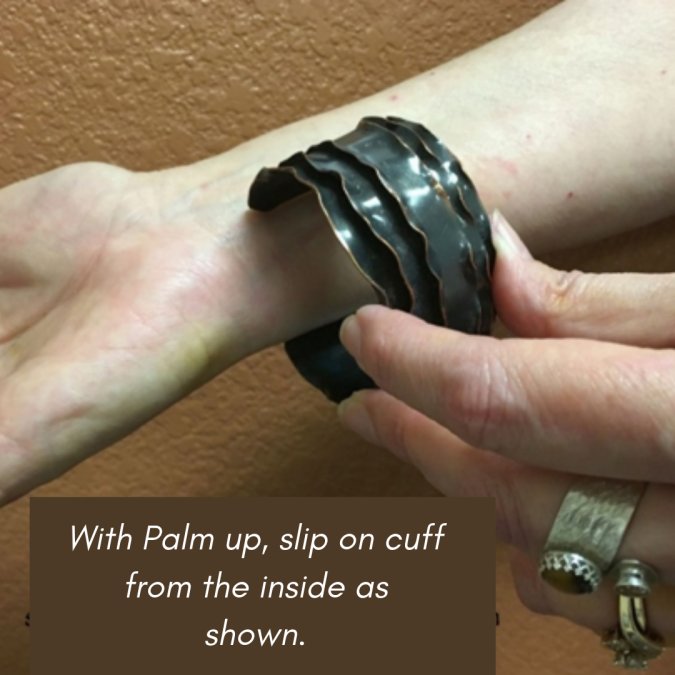
Cuff Opening and Wrist Measurement
Measure your wrist with a soft tape measure just below the wrist bone. Most of our cuffs fit wrists between 6 and 7 1/2 inches, and each listing states the exact circumference and opening.
A cuff opening lets you put the bracelet on sideways, then rotate it into place. To adjust, apply gentle, even pressure with both thumbs. Never force a cuff open and closed repeatedly, because metal fatigues over time.
Handmade Cuff Bracelets in Sterling and Fine Silver
Sterling and fine silver are the backbone of most handmade cuff bracelets. Sterling silver is an alloy, usually 92.5 percent silver mixed with copper for strength. Fine silver is nearly pure, softer and brighter.
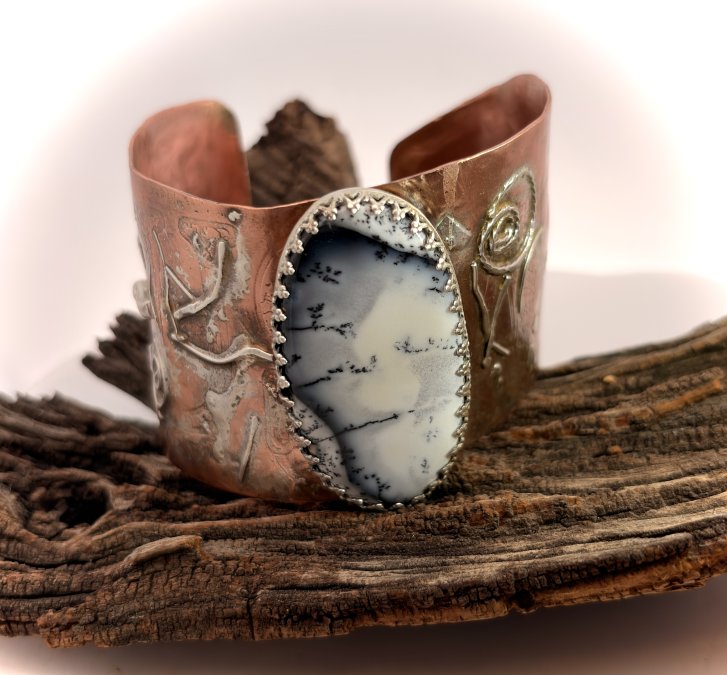
One of a Kind Handmade Jewelry Gifts: 2026 Guide
My 'Lavender Fields' Sterling and Charoite Cuff uses sterling silver as its base, with sterling components fused in and a rich purple charoite from Russia as the centerpiece. It measures 3/4 inch wide with a 6 1/2 inch circumference and a 1 1/4 inch opening, fitting wrists from 6 to 7 1/4 inches.
The 'South Seas Treasure' Fine Silver and Carnelian Cuff takes the opposite approach. A form-folded fine silver base carries fused silver components and a carnelian gem, at 1 1/4 inches wide. Both ship free within the USA and arrive gift wrapped.
SHOP MY CUFFS HERE
Sterling Silver Cuff Bracelets: What the Hallmark Means
A hallmark is a small stamp identifying a piece's metal purity. In the United States, sterling silver is legally defined as containing at least 92.5 percent silver.
That stamp matters for two reasons. It confirms you are paying for real silver, not a silver-plated base metal, and it tells you how the piece will age. Sterling develops a soft patina over time; a quick polish with a silver cloth restores the original shine.
When you buy handmade, ask where the hallmark sits and what it says.
Gemstone Cuff Bracelets: Charoite, Jasper, Moonstone, and More
Gemstone cuff bracelets let a single stone carry the design. Each gem brings its own color story, and because most handcrafted pieces use one-of-a-kind stones, no two cuffs look alike.
Here is how the main gemstone families compare:
Gemstone |
Color Character |
Best For |
Example Piece |
|---|---|---|---|
Charoite |
Rich purple and lavender swirls |
Statement evening wear |
'Lavender Fields' Cuff |
Picture Jasper |
Caramel and brown landscape bands |
Earthy, everyday style |
Desert Sands Collection Cuff |
Dendritic Opal |
White with black fern-like patterns |
Conversation pieces |
Merlins' Magic Cuff |
Moonstone |
Opalescent, moonlit glow |
Elegant neutral outfits |
'Slice of Moonlight' Cuff |
Carnelian |
Warm orange-red |
Boosting a plain outfit |
'South Seas Treasure' Cuff |
Smoky Quartz |
Deep translucent brown |
Subtle daily wear |
'Chocolate Love' Cuff |
The Desert Sands Collection Picture Jasper Fine Silver Cuff measures 1 inch wide with a 1 1/2 inch gem, its caramel and brown tones echoing desert landscapes. The Merlins' Magic Copper, Sterling, Dendritic Opal Cuff sets a 1 3/4 inch dendritic opal on a textured copper and silver base.
For something softer, the 'Slice of Moonlight' Golden Steel Cuff pairs perforated steel drenched in 18k gold with a supersized moonstone. Its flexibility lets you shape it to your wrist with light pressure.
How to Style Cuff Bracelets for Everyday and Occasions
Styling a cuff is easier than it looks: let the cuff be the loudest thing you wear. A wide, gemstone-heavy piece needs quiet company, and what separates a styled cuff from a cluttered wrist is the balance of width, metal, and neckline.
Start with proportion. A cuff 1 inch wide or more reads as a statement, so keep the rest of your jewelry thin; a cuff under 3/4 inch can carry one or two companions without competing.
Then match the cuff to the neckline. An open or V-neckline leaves room for a wide cuff to sit alone, while a high neckline or turtleneck crowds it, so choose a narrower band or push the cuff over a sleeve.
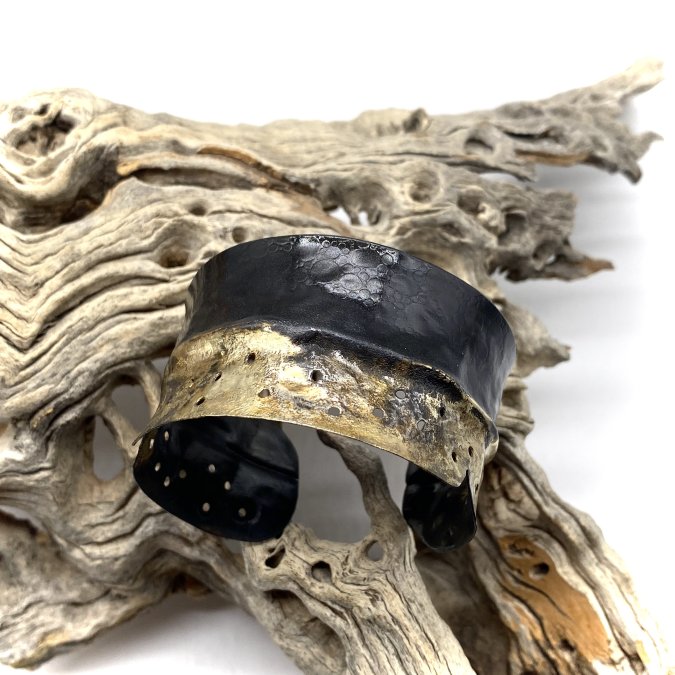
For everyday wear, pair a single cuff with a plain long-sleeve top or a simple dress and let the metal do the talking.
For occasions, choose the gemstone to match the mood. Charoite and moonstone suit evening events and formal dinners. Carnelian and jasper work well for outdoor gatherings and casual celebrations. Here is how that plays out across common settings:
- Office: one thin silver or steel cuff, sleeve pushed to the forearm, no stacking so it stays quiet at a desk
- Weekend: a copper or jasper cuff with denim and a white shirt, worn alone or with one thin leather band
- Evening: a wide charoite or moonstone cuff over a dark dress, with stud earrings rather than a necklace so the wrist stays the focal point
- Western-inspired: a turquoise or picture jasper cuff with a denim jacket, a leather belt, and boots; keep rings minimal so the cuff leads
- Gifting: a piece with a romance card that tells the stone's story, sized to the recipient's wrist measurement rather than guessed
Stacking has one mechanical rule: put the widest, heaviest cuff closest to the wrist bone and the thinnest pieces above it, which keeps the stack from sliding and protects a soft or textured cuff from rubbing against harder metal.
Price, Value, and What the Numbers Tell You
Price in handcrafted jewelry reflects three things: the metal, the stone, and the hours of work, which is why two cuffs of similar size can sit far apart in cost.
Our cuffs range from $165 for the 'Chocolate Love' Smoky Quartz Cuff to $410 for the 'Slice of Moonlight' Golden Steel Cuff.
Piece |
Price |
Metal |
Gemstone |
|---|---|---|---|
'Chocolate Love' Cuff |
$165 |
Copper |
Smoky quartz, citrine |
'Dare to Dream' Cuff |
$170 |
Copper, sterling |
None |
Merlins' Magic Cuff |
$240 |
Copper, sterling |
Dendritic opal |
'Memories of Childhood' Cuff |
$275 |
Copper, sterling |
Rainbow solar quartz |
'Lavender Fields' Cuff |
$320 |
Sterling silver |
Charoite |
'South Seas Treasure' Cuffs |
$350 |
Fine silver |
Carnelian or grape agate |
Desert Sands Collection Cuff |
$375 |
Fine silver, sterling |
Picture jasper |
Golden Steel Cuff |
$395 |
Steel, 18k gold |
None |
'Slice of Moonlight' Cuff |
$410 |
Steel, 18k gold |
Moonstone |
To read that table as a value comparison, weigh four factors:
Metal cost and durability. Copper and sterling sit at the lower end because the raw material is less expensive, and both develop a patina. Fine silver is softer and brighter. Steel with a gold finish costs more because the base is strong and the finish adds a step. A higher price here buys longevity and a finish that holds up to daily wear.
Stone rarity and size. A one-of-a-kind charoite or dendritic opal costs more than a common quartz because the material is harder to source and each stone is unique.
Construction and finish. A cuff that is form-folded, fused, and hand-textured takes more hours than a simple band.
Adjustability. An open cuff that can be gently shaped to your wrist extends the life of the piece and reduces the chance you outgrow the fit. A fixed bangle cannot do that.
What the numbers do not show is longevity. A mass-produced cuff costs less because the labor is compressed into a machine cycle. A handcrafted cuff costs more because one person fused, textured, and finished it.
A practical way to compare: divide the price by the number of years you expect to wear it.
Conclusion: Finding Your One-of-a-Kind Cuff
The hardest part of buying a handcrafted cuff is not the price. It is choosing between pieces that each feel like they were made for you, because in a real sense they were.
At Alene's Adornments, every cuff is made by hand in my studio, using fine and sterling silver, gold, steel, copper, and genuine gemstones. Each design is a limited edition of one, so the piece you choose will not appear on anyone else's wrist. I also offer personal consultations by Zoom or in person if you want help matching a cuff to your style or a specific occasion.
Join my Collector's List today to see new one-of-a-kind pieces first.
Frequently Asked Questions
How should a handcrafted cuff bracelet fit?
Measure your wrist with a tape measure and compare it to the cuff's listed circumference and opening. Most cuffs here fit wrists from 6 to 7 1/2 inches, depending on the piece. A well-fitted cuff slides over the narrowest part of your wrist and stays put without pinching. You can gently adjust the opening once or twice, but repeated bending weakens the metal over time.
What materials are commonly used in handcrafted cuff bracelets?
Artisan makers work in sterling silver, fine silver, copper, and gold. Each metal behaves differently: copper develops a patina unless sealed. Gemstones like turquoise, charoite, jasper, and moonstone are often set as the focal point.
Can you wear a cuff bracelet every day?
Yes, if the metal suits your routine. Steel and sterling silver cuffs handle daily wear well. Copper pieces are usually treated to slow oxidation, so they need occasional wiping. Remove your cuff before heavy lifting, swimming, or cleaning with harsh chemicals. Storing it in the gift box it arrived in keeps the finish intact between wears.
How do you style cuff bracelets with other jewelry?
Wear a wide, gemstone-heavy cuff alone on one wrist so it stays the focal point. On the other wrist, stack thin bangles or a simple chain. Match metal tones loosely rather than exactly; warm gold pairs fine with copper, and silver sits well beside steel.
Are handcrafted cuff bracelets worth the price?
Pieces in this collection run from $165 to $410, and each one is a limited edition of one. You are paying for hand-fused metalwork, a specific gemstone, and a design that will not be reproduced. Compare that to mass-produced cuffs that cost less but appear on thousands of wrists. Free US shipping and gift wrapping are included on every piece.