
How to Commission a Custom Turquoise Pendant
Last Updated: November 20, 2026
Quick Summary
A custom turquoise pendant is designed one-on-one with you, starting from your vision rather than a catalog page. Each piece is built by hand, with you choosing the stone, metal, shape and chain before fabrication begins.
- Start with a consultation, in person or over Zoom, to share your style and stone preferences.
- Choose natural turquoise, judging color, matrix and shape for how the pendant will look and wear.
- Ask about the stone's source and whether it is natural, stabilized or dyed before approving.
- Bezel settings best protect turquoise from knocks, while prongs can chip a soft stone.
- Approve the stone, metal and design sketch before cutting begins, since changes are costly afterward.
What Custom Turquoise Pendant Design Services Include
Custom turquoise pendant design services take an idea from a rough sketch to a finished piece you can wear. I work one-on-one with each client, so the process starts with your vision rather than a catalog page.
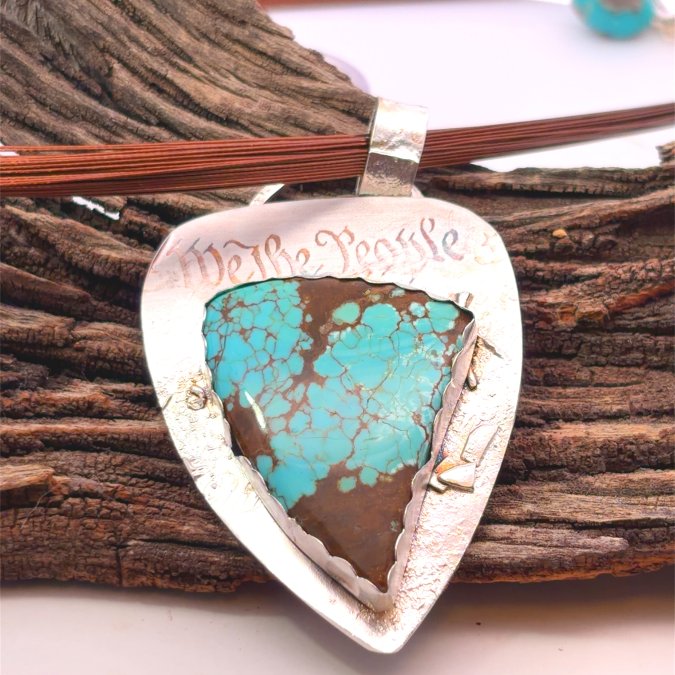
A typical commission covers a few core steps. We talk through the stone, the metal, the shape and the size. I then draft a design, refine it with you, and build the pendant by hand in my Arizona studio.
Services usually include:
- A design consultation, in person or over Zoom
- Stone selection from a gem inventory I source myself
- Metal and setting choices, such as sterling silver or fine silver
- Chain or neck wire selection and sizing
- Finishing, cleaning and gift packaging
I keep the process flexible on purpose. If you have a specific stone in mind, or a symbol you want worked into the metal, that goes into the design brief.
Choosing the Turquoise Stone for Your Pendant
Turquoise varies more than most people expect. Color, matrix (the dark veining in the stone), and hardness all change how a pendant looks and wears. Two stones that look similar in a photo can feel very different in person.
Natural turquoise is the stone I work with. At Alene's Adornments, the turquoise I use is natural, and each stone is sourced personally by the owner. Each stone is chosen for color and matrix, because those features set the tone for the whole design.
Before you settle on a stone, consider:
- Color: Sky blue, deep blue, and green-blue each suit different styles.
- Matrix: A web of brown or black veining can add character. Some people prefer an almost matrix-free stone.
- Shape and size: A large cabochon makes a statement. A smaller stone suits everyday wear.
How to Assess Turquoise Quality and Origin
Quality in turquoise depends on color evenness, hardness, and how the stone was treated. Ask the maker where the stone came from and whether it is natural, stabilized or dyed. A reputable designer should answer these questions plainly.
Look closely at the stone under daylight. Natural turquoise shows slight variation in color and matrix. Uniform color can point to dye or a composite. I can tell you the source of the stones I use and explain any treatment.
Turquoise Pendant Design Ideas to Consider
A pendant is a good place to show personal style, because it sits close to the face. The shape, the metal and the frame all affect the final look.
Some directions clients often explore:
- Bold statement pendants with a large stone set in a sturdy silver bezel
- Layered metal designs that combine sterling and fine silver for contrast
- Symbolic shapes such as butterflies, hearts or spirals
- Minimal pendants with a small stone and a clean silhouette
Pairing matters too. A bold pendant may need a simple chain so it does not compete with the neckline. A delicate pendant can carry a textured chain.
You can browse finished work from my current collection for inspiration. The Natural Nevada Turquoise Pendant shows how a natural stone looks set in silver, and the Transformation Sterling And Turquoise Butterfly Pendant shows a symbolic design built in two layers of silver.
Choosing a Sterling Silver Setting and Construction
The setting does two jobs at once: it holds the stone securely and it sets the visual character of the pendant. Turquoise is softer and more brittle than quartz or sapphire, so the construction choices you make at the design stage determine how the piece wears, how it ages, and how easily it can be repaired later.
Here is how the main setting approaches compare for a turquoise pendant:
- Bezel setting. A continuous metal rim is folded over the stone's edge. It is the most protective option for turquoise because the rim shields the girdle (the stone's outer edge) from knocks. The trade-off is that a bezel hides the stone's edge, so a very thin or uneven cabochon may need a taller rim, which adds visual weight. Bezels are also straightforward to re-tighten if the stone ever loosens.
- Prong setting. Metal claws hold the stone at several points. Prongs show more of the stone and read as lighter and more open. For turquoise, though, prongs concentrate stress on small contact points, and a soft stone can chip at a prong tip if the pendant is knocked against a hard surface. Prong work also needs periodic inspection and tightening.
- Inlay. Pieces of turquoise are set flush into channels or recesses cut into the metal, producing a smooth, continuous surface. Inlay suits geometric and channel designs and wears well because nothing protrudes. The trade-off is that inlay is labor-intensive, and a dropped or chipped section is harder to repair than a single cabochon because the replacement piece must match the surrounding color and matrix.
- Crushed-stone (chip inlay). Crushed turquoise is packed into recessed channels with epoxy or resin and sanded flush. It allows fine linework and mosaic patterns that a single stone cannot achieve. The trade-off is durability: resin can shrink, yellow, or loosen over years of wear, and the piece may need re-finishing. Ask how the channels are sealed and whether the maker will service them.
Metal choice interacts with all of this. The metals I use include sterling silver and fine silver, and I fuse smaller sterling and fine silver elements together to create designs.
Construction details worth asking about before you approve a design:
- Bail style and attachment. A soldered bail is stronger than a jump ring threaded through a loop. For a heavy stone, ask for a wide bail or a hidden tube bail so the pendant hangs straight and the chain does not wear through a thin loop.
- Backplate and open-back design. A solid backplate adds strength and can be textured or stamped; an open-back setting lets light through the stone but exposes the back of the cabochon. For everyday wear, a solid or partially open back is usually the more durable choice.
- Joint quality. Look for soldered seams rather than glued or pressure-fit joints. Solder joints should be clean and fully flowed, not lumpy or pitted.
- Chain compatibility. Match the chain's weight and clasp to the pendant. A heavy cabochon on a fine cable chain will stretch the chain and strain the clasp; a heavier chain or a neck wire distributes the load better.
- Repair access. Ask how the stone is held and whether the setting can be opened for repair without damaging the bezel. A setting that cannot be safely opened limits future service options.
The main setting approaches for a turquoise pendant differ in protection, visual weight, and repairability:
Setting |
Main advantage |
Trade-off |
|---|---|---|
Bezel |
Shields the stone's edge from knocks |
Hides the stone's edge; adds visual weight |
Prong |
Shows more of the stone; lighter look |
Concentrates stress; can chip soft turquoise |
Inlay |
Smooth surface; nothing protrudes |
Labor-intensive; hard to repair |
Crushed-stone (chip inlay) |
Allows fine linework and mosaic patterns |
Resin can shrink, yellow, or loosen over time |
How to Commission Custom Jewelry, Step by Step
Commissioning custom jewelry goes more smoothly when you know the steps in advance. Here is the process I follow with clients:
- Share your idea. Describe the style, the mood, and any stone or symbol you want.
- Book a consultation. We talk in person or by Zoom to refine the brief.
- Review a design draft. I sketch the pendant and you approve or request changes.
- Confirm the stone and metal. You see the actual stone options before cutting begins.
- Build the piece. I handcraft the pendant in the studio.
- Approve the final result. You review the finished pendant before it ships.
Clear communication at each step prevents surprises. If something in the sketch does not match what you pictured, say so early. Changes are much easier at the drawing stage than after the silver is set.
Watch out: vague briefs cause most delays. "Something blue and simple" leaves too much open, so bring a few reference images or a clear description of what you want.
How Long It Takes to Make a Custom Pendant
Timelines for a custom turquoise pendant are driven less by the handwork than by the decisions and approvals along the way.
A typical sequence looks like this:
- Consultation and brief. You share references, stone preferences, and how you plan to wear the piece. This usually happens in one session, but a complex symbolic design may need a follow-up call.
- Stone selection. I present stone options for you to review. If you want a specific mine or a particular shape, sourcing can add time; if you are flexible, this step moves quickly.
- Design draft and revisions. I sketch the pendant and send it for review.
- Design approval and confirmation. You sign off on the drawing, the stone, the metal, and the chain. This is the point of no return for the design, because changing the layout after the silver is cut means starting over.
- Fabrication. I build the pendant by hand: forming the setting, setting the stone, finishing, and polishing.
- Final approval and shipping. You review photos of the finished pendant before it ships. If something does not match the approved design, this is the moment to raise it.
Revision expectations are worth setting up front. Ask about revisions before fabrication begins and what happens if you want a change after the design is approved.
If you have a gift date or event, tell me at the first consultation. Working backward from a deadline tells us whether the schedule is realistic and whether a simpler design would serve you better.
Watch out: the most common cause of delay is a vague brief that forces repeated redesigns, so bring reference images and a clear description of the stone color, shape, and mood you want before the first consultation.
Booking Your Custom Pendant Consultation
A consultation is the best first step. We can talk through your ideas, look at stone options, and decide whether a custom piece fits what you want.
To prepare, gather a few reference images, note any stone color you like, and think about how you plan to wear the pendant. Bring your existing necklaces if you have them.
To start, reach out to book your consultation. Explore the Nevada Turquoise & Garnet Fine Silver Pendant Necklace for a sense of how I combine stones and silver, and then tell me what you have in mind.
Ready to create a turquoise pendant that is yours alone? Join my Collector's List today to hear about new work and custom openings first.
Frequently Asked Questions
How much does it cost to have a custom pendant made?
Costs depend on the stone, the metal and the complexity of the design. Pieces in my shop range from $190.00 for a copper and silver turquoise spiral necklace to $340.00 for a larger Nevada turquoise and silver statement pendant. Free shipping within the USA is included on finished pieces.
How do I get a custom turquoise pendant made?
Start by contacting me through an in-person consultation or a Zoom meeting to describe what you have in mind. Bring any sketches, photos or inspiration images, and tell me which stone color and silver style you prefer.
How long does it take to make a custom turquoise pendant?
Timing varies with design complexity, stone sourcing and how many revisions you request. Simpler silver settings move faster than intricate fused silver work. Plan for the design and approval stage to take a few rounds of discussion before construction starts, then allow time for the handcrafted build. I confirm an estimated completion date when you approve the design.
What should I share with a jewelry designer before commissioning a pendant?
Share the occasion or purpose of the pendant, the size and shape you like, the stone color and matrix you prefer, and the metal you want. Include inspiration photos and any symbolism that matters to you. Mention your budget early so the design can fit it. Clear details at the start reduce revisions and keep the approval checkpoints on schedule.
